



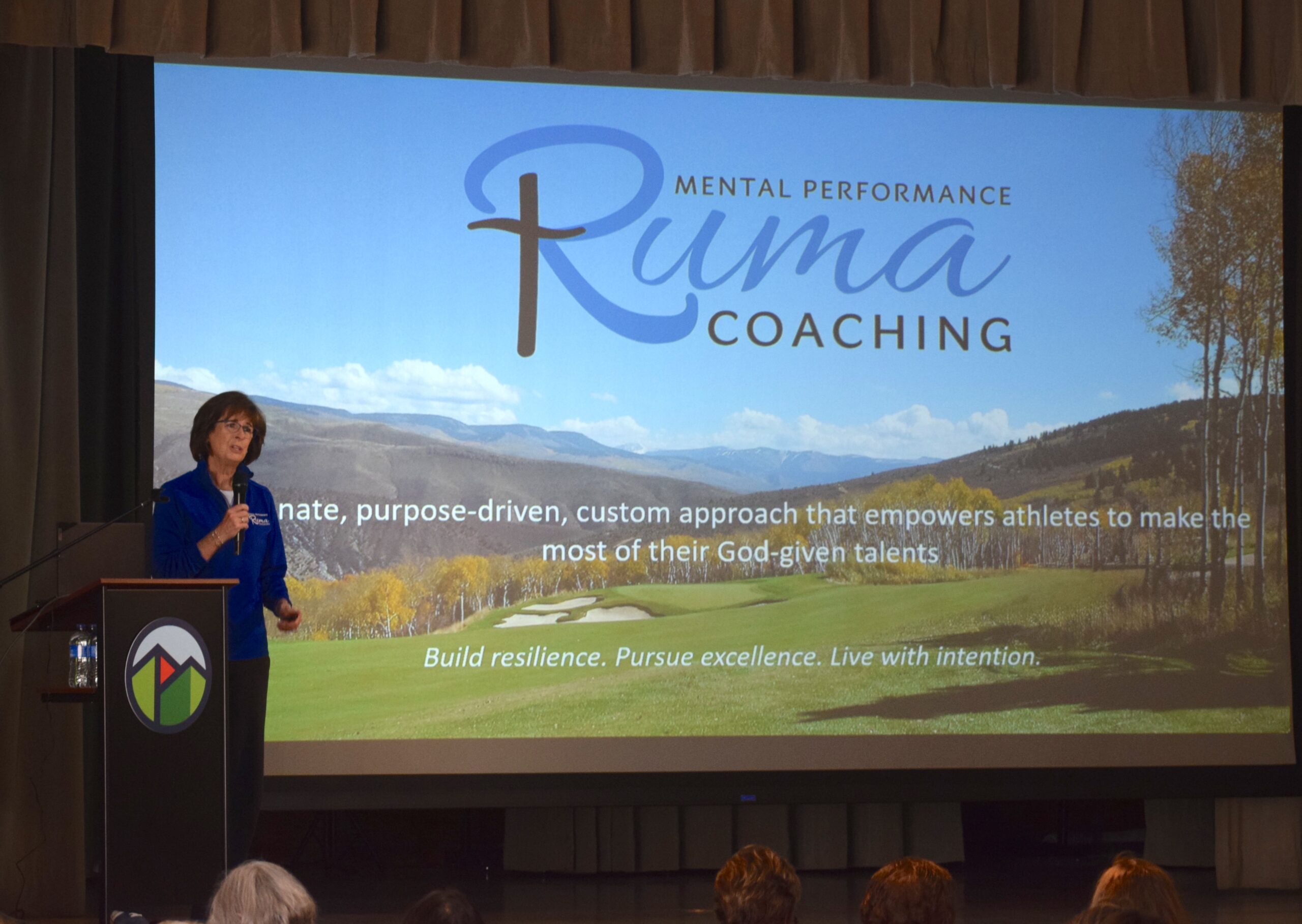
After long being one of Colorado’s most accomplished female players, Colorado Golf Hall of Famer Janet Ruma Moore starting a new chapter — as a mental performance coach
By Gary Baines – 3/5/2026
The scene where Janet Ruma Moore competed in her first U.S. Senior Women’s Open, in 2018, remains vivid in her mind to this day.
At Chicago Golf Club in Wheaton, Ill. — coincidentally where she coached the Wheaton College women’s golf team earlier that decade — the Colorado Golf Hall of Famer received a reality check of sorts one day. Mainly that came in the form of World Golf Hall of Famers here, there and everywhere.
“I turned the corner as we came up, and there was JoAnne Carner, of all people,” Moore noted. “Ask me if I ever thought I’d play in a tournament with JoAnne Carner — Big Mama? It was an incredible experience. We were in the hospitality area with Juli Inkster, Laura Davies, Jan Stephenson — all the names I grew up watching.”
With that as a backdrop, Moore recounted how she dealt with that scene as an amateur golfer — albeit a highly accomplished one in Colorado.
“I teed off; my first hole was No. 10 at Chicago Golf Club, a par-3,” she said. “My focus was on the gallery watching me, the lake in front of me, and the green that slopes back to the lake. And, if I’m being completely transparent, thinking, ‘Janet, if you hit it on the green, you can putt it back into the lake.’
“My focus was not where it should (have been).”
Telling this story last Saturday as part of a presentation at the CGA Women’s Golf Summit at the Denver Botanic Gardens, Moore continued — with the hopes of making a point.
“Fast forward five years — to 2023. I’m in Oregon playing in the Women’s Senior Open,” she said. “But by now I’d learned what I could control and where to place my focus. I show up, and my clubs don’t. I don’t have the clubs for my practice round. I have the world’s best caddie — he’s my husband, Kent. He gets sick and can’t caddie for me. So now I have no clubs, no caddie, I’m dealing with a wrist injury, then I start to get sick. It was a comedy of errors. But I knew where to place my focus. I had the best tournament I ever have of the four Senior Opens I’ve played in. I didn’t make the cut, but I came within (two). With all those things going on, I knew where to place my focus.”
So what’s the difference between those scenes in 2018 and ’23?
“Nothing has changed other than where you put your focus,” she said. “You still have the same swing, you’re still the same person. The only thing that has changed is where you’re placing your focus.”
We note all this because in the case of Moore, her focus has indeed changed in recent years — at least professionally speaking. Specifically, a little less than three years ago, she started on the pathway toward become a mental performance coach for athletes — very definitely including golfers, but others as well. Last year she started her company, Ruma Coaching (using her maiden name in the business name), and last Saturday she gave a 35-minute-long presentation to the 150 people who attended the CGA Women’s Golf Summit.
Moore, a Colorado native and Wheat Ridge High School graduate, certainly is no stranger to anyone who has followed golf closely in the state. In the 1990s, the former University of Arizona golfer won a remarkable five state amateurs, prevailing at the CWGA Stroke Play in 1991, ’94, ’95, ’96 and ’97. In all, she owns 26 CGA/CWGA titles and has qualified for more than 35 USGA championships. She was inducted into the Colorado Golf Hall of Fame in 2001 at age 36. (Her husband, Kent, was enshrined in 2004.)
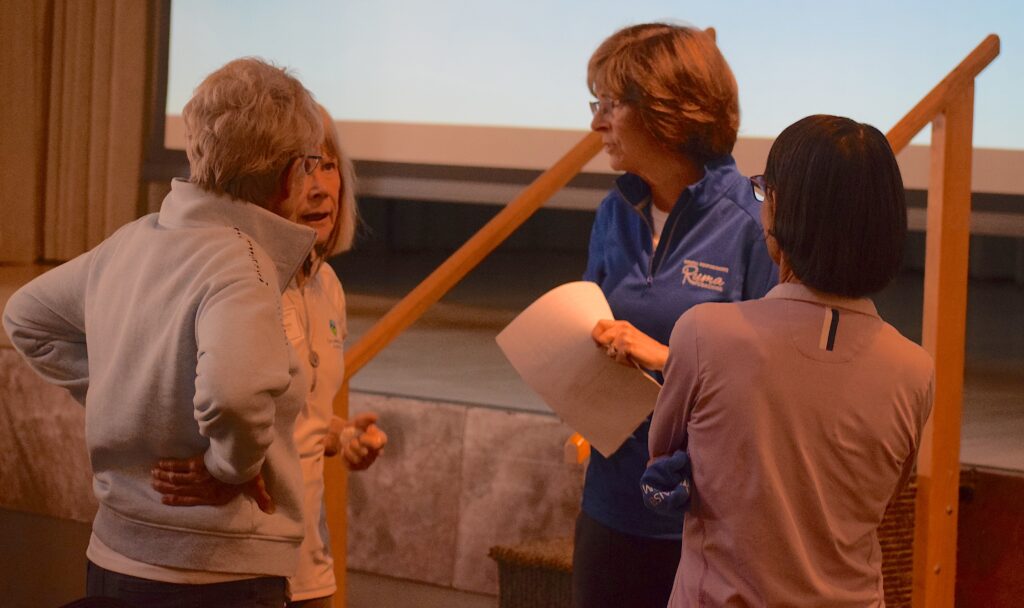
Moore (in blue) chats with some CGA Women’s Golf Summit attendees after her presentation.
But even with all those accomplishments, Janet Moore was seeking some help a few years ago in getting the most out of her golf game. She noted that Wyndham Clark — who grew up playing Cherry Hills Country Club, where Moore is a longtime member — had taken his game to another level (two PGA Tour wins, including the U.S. Open, in 2023) after working with performance coach Julie Elion.
“I had had some injuries and had lost some of my confidence” as a competitive golfer, Moore said in an interview with Colorado Golf Journal after her Women’s Summit presentation. “And so I decided that if I’m going to take my game to the next level, I’m not only going to have to be better physically, but also better mentally.”
And when Clark noted on TV that he had been working with Elion, Moore thought, “‘Oh, I’m looking for a mental performance coach, I’ll call her.’ I had no idea she works with all sorts of professional athletes. But for some reason she said ‘yes’ that she’d work with me. It was amazing and I was so grateful. So we started working together, and about three months into it she said, ‘Janet, you should think about doing this (being a performance coach). You’d be good at this.’
“I had thought about going back and getting my Masters degree before. That was the impetus of like, ‘I’m going to do it.’ So literally, I started my Master’s (at Grand Canyon University, a private Christian school based in Phoenix). I took a year and a half to complete it and got my Master’s in Psychology.”
She did so at GCU because “for me, it was really important to have the faith aspect of it. Not all my clients are faith-based, but they understand that’s my bent, so that’s why I chose (GCU).”
Between her work for her Masters and being a client of Elion’s, Moore said she received plenty of worthwhile lessons.
“I learned so much,” she said. “And (Elion is) the best at kind of digging deep and finding the why — why you do certain things and stuff and having you be aware of it. So I’m so grateful for what I’ve learned from her. She’s just incredible. “
And the situation with Elion went beyond client and player, and mentor and mentoree. After Moore received her degree last May — and had had Elion coach her for a couple of years — Elion suggested a teaming up of sorts.
“Julie said ‘Janet, I’d like you to come on our team and be a faith-based coach, because we don’t have that niche,’” Moore recounted.
So Moore then started her own company, Ruma Coaching — “a kind of a nod to my parents”. RUMA is also an acronym for Moore regarding how she guides clients: Realize potential; Understand grace; Meaning in the journey; and Appreciate the challenge.
“That’s the acronym for Ruma, but I was really pleased that I could kind of use that as my company.name.”
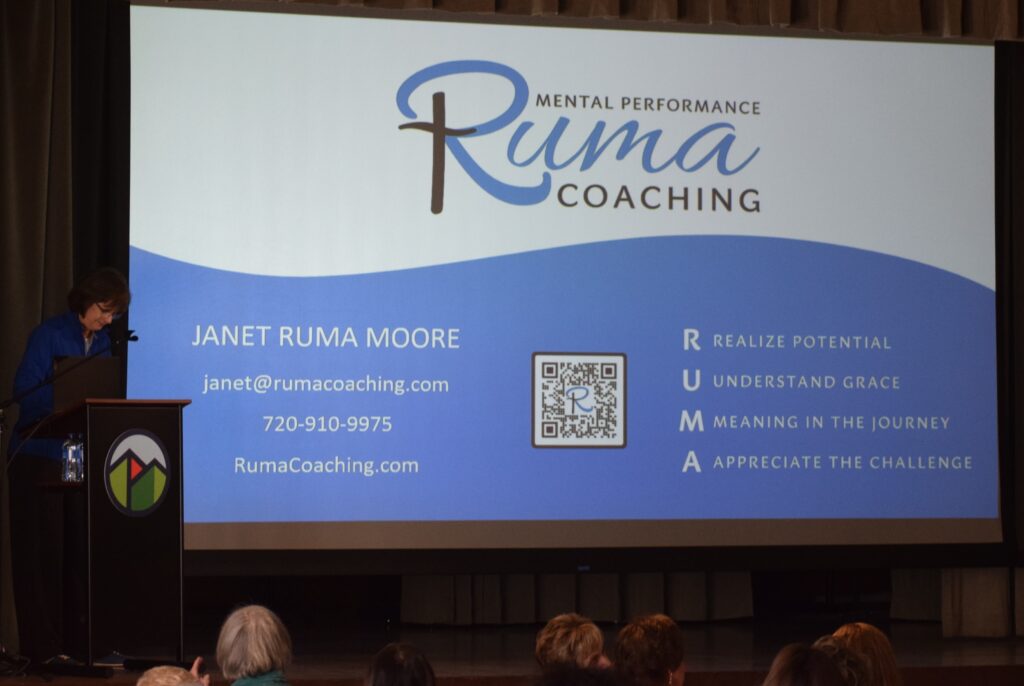
Moore is a former client of Julie Elion, who has served as a performance coach for 2023 U.S. Open champion Wyndham Clark. Moore now is part of Elion’s team, along with owning her own company.
Certainly at the CGA Women’s Golf Summit, Moore was a very engaging presenter. At one point, she noted that Roger Federer, one of the most successful tennis players of all time, won almost 80 percent of his matches over his career, but just 54 percent of the points he played. What sets Federer — and other top-level competitors — apart can often come down to overcoming mental barriers, such as trying as hard as you can during each point, but not dwelling shots — win or lose — after the fact. That frees up an athlete to focus on the next point and the point after that, etc.
“Whatever game you play in life, sometimes you’re going to lose — a point, a match, a season, a job. It’s a rollercoaster, with many ups and downs,” Federer once noted. “… Negative energy is wasted energy. You want to become a master at overcoming hard moments. That is, to me, the sign of a champion. The best in the world are not the best because they win every point. It’s because they know they’ll lose again and again, and have learned how to deal with it. You accept it, cry it out if you need to, then force a smile. You move on, be relentless, adapt and grow, work harder, work smarter.”
And — as Moore noted on Saturday — also very important is focusing on what you can indeed control, regardless of the circumstances — which is more things than you might imagine: your breathing; pre-shot routine; body language; commitment; your gratitude, which lowers anxiety; and “kind self-talk,” Moore said.
So in addition to owning and operating Ruma Coaching, Moore is part of the 11-person team at Elion’s company, CAPE.
Moore said the number of clients she’s currently working with in her first year in the business is under 10 — a total she thinks make sense so as to serve them all well. They include not only golfers, but athletes in track and field, and cycling.
Moore believes the fact that she’s been a high-level competitive golfer serves her and her clients well in mental performance coaching. With her golf clients, it’s not unusual for Moore to work with them on the golf course, as well as simply talking through relevant matters off the course.
“I do think one advantage that I have is that I’ve competed and I know what it feels like to stand over that 3-foot putt or stand on that first tee and think about the lake,” Moore said. “I can try to apply these things. The Senior Open, I had two scorers come up to me during those qualifying rounds and say, ‘You have the best attitude I’ve ever seen’. If I hadn’t worked with Julie and all the things that had been happening, I’m not sure I would have had that kind of attitude.
“I’ve personally experienced it, I’ve seen it with my clients and my athletes. It is so rewarding (to help them). I love it. So I do think it helps having played competitive golf.”
By the way, in addition to working directly with clients, Moore is also sharing her mental performance tips with other CGA members as she’s writing periodically for the CGA Monthly publication.
As far as her personal golf goes, Moore has been largely sidelined for about a year and a half due to injuries. In recent years, she’s battled knee, shoulder and chronic wrist problems. And though the wrist remains the key issue at this point regarding her golf game — “I’m holding everything really lightly and I’m seeing what happens,” she said — she doesn’t know what the future may hold for her regarding competing further.
The break from competing “was a blessing to me because I was really able to focus on this — the mental performance coaching, and I can’t tell you how much I love it,” Moore said. “It is so much fun working with these kids and adults. I have both ends of the spectrum, and they’re not all golfers. It’s amazing.
“But I must say, I miss being with my friends (while playing on the golf course) — and with my friends who compete on the national level. We stay in touch, but it’s just not the same. That honestly might be my incentive (to try to overcome the injuries and return to playing).”
The bottom line is that Moore hopes her injuries allow her to play at a very high level again, but in either case, mental performance coaching is a very satisfying way of staying involved in competitive sports.
“I love coaching one-on-one, and I love it with bigger groups,” she said. “I love it all.”
About the Writer: Gary Baines has covered golf in Colorado continuously since 1983. He was a sports writer at the Daily Camera newspaper in Boulder, then the sports editor there, and has written regularly for ColoradoGolf.org since 2009. The University of Colorado Evans Scholar alum was inducted into the Colorado Golf Hall of Fame in 2022. He owns and operates ColoradoGolfJournal.com